Ask a room of adults why they have never tried yoga and the answer comes back in one voice: I am not flexible enough. It is the single most common reason people in Cornelius give for staying out of a practice that would, among other things, make them more flexible. The logic defeats itself, but the feeling underneath it is real: adults remember being bendy at nine, test themselves against a toe-touch at forty, and conclude the door is closed. It is not closed. It never had a flexibility lock on it.
Here is what stiffness actually is, what yoga does to it, and what progress honestly looks like at different speeds.
The numbers that put stiffness in perspective
What stiffness really consists of
Three separate things get bundled into the word stiff. First, muscle tissue that has shortened around the positions you actually use: eight hours in a chair teaches hamstrings and hip flexors a length and they keep it. Second, joint range limited by habit rather than damage: shoulders, spine, and ankles that simply have not visited their full range in years. Third, and underrated, the nervous system's guard: muscles resist stretching partly as protection, and they relax that guard when movement is slow, repeated, and safe, which is a fair description of a well-taught class. Two of those three respond well to practice. The guard responds fastest, which is why beginners often gain visible range in the first month: much of it was permission, not tissue.
What progress actually looks like
Forget the toe-touch as a scoreboard. Real progress shows up in daily clothing-and-stairs terms: tying shoes without bracing on the wall, turning to check a blind spot with your whole head instead of your whole torso, getting up from the floor with less negotiation, a back that does not file a complaint after yard work. In class it looks like a strap getting shorter, a block going from its tallest side to its lowest, a forward fold measured in inches of ease rather than a destination. Timeframe honesty: people who practice twice a week usually feel a difference in four to six weeks and see an obvious one by three months. Once a week still helps; it just writes the story slower.
How classes are built for stiff bodies
Props exist precisely for this. A block brings the floor closer. A strap extends your arms by a foot. A blanket under the hips changes an impossible seated fold into a comfortable one. Teachers at community studios expect stiff beginners; entire sequences are designed for them, and modifications are offered as the default, not as a remedial track. The one habit that slows progress is forcing: muscling into a stretch triggers the guard reflex and can strain tissue. Yoga's instruction to work at the edge of comfort, never pain, is not philosophy. It is mechanics.

The comparison trap
The person on the next mat folding in half started somewhere too, possibly years ago, possibly with a different skeleton: hip sockets genuinely vary between people, and some ranges are bone, not effort. Comparing ranges in a yoga room is like comparing handwriting in a classroom: visible, irrelevant, and a reliable way to ruin a good hour. The useful measure is last month's version of you. Stiff beginners, oddly, get the best of this deal, because their improvements are the largest and the most obvious, in class and at the shoe rack.
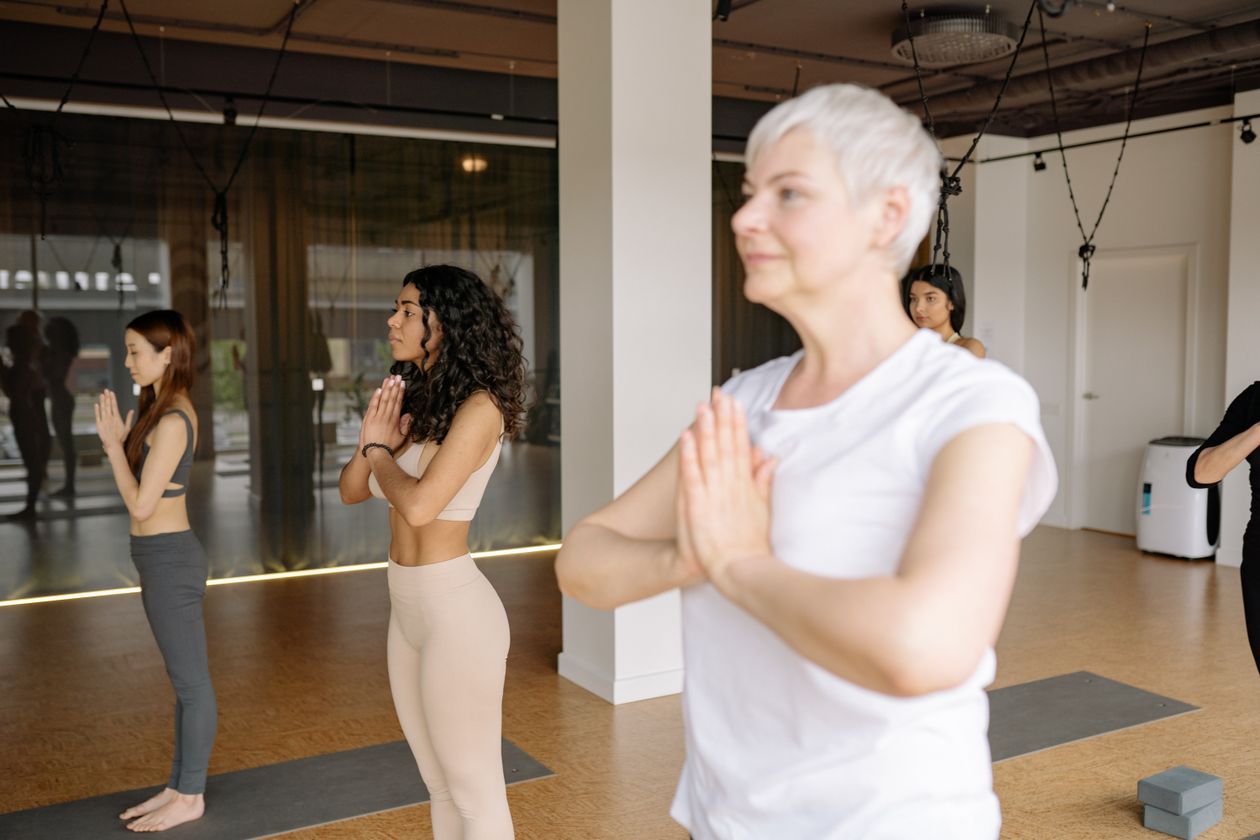
Age deserves a word here too, because it comes up in every beginner conversation. Range of motion does narrow with age when it is not used, and widens, within your own structure's limits, when it is. Practitioners who start at sixty improve on the same curve as practitioners who start at thirty; they are simply starting from a different point on it. The practice does not ask where you started. It only compounds from there.
Common questions
Will yoga make me as flexible as the teacher?
Probably not, and it does not need to. You will very likely become much more flexible than you are now, which is the range your daily life actually uses.
Should I stretch at home between classes?
Gentle movement helps, especially for hips and hamstrings after desk days. Keep it mild and regular rather than intense and rare, and never force a cold stretch first thing.
Is soreness after class a bad sign?
Mild muscle soreness a day later is normal, especially early on. Sharp pain, joint pain, or soreness that worsens over days means ease off and mention it to the teacher.
Photos in this guide are representative stock images.
← All guides from Community Yoga← Back to Community Yoga